What We’re Learning About AI Avatars in Japan
How conversations with Japanese partners, customers and developers are shaping the way we build Perxona
Entering a new market is always a learning experience. What may seem straightforward from outside can look quite different once you begin speaking with companies, partners, developers, and potential customers who understand the market from the inside.
That has certainly been our experience in Japan.
Over the past year, we have had conversations with Japanese companies and potential partners across hospitality, tourism, retail, exhibitions, corporate services, and other industries. We have demonstrated Perxona, discussed possible applications, listened to questions and feedback, and had opportunities to see how an AI avatar might fit into real customer experiences in Japan.
We have also taken a more hands-on approach to learning. In addition to customer and partner conversations, we have hosted workshops and brought developers together through an AI Avatar Hackathon in Tokyo. These experiences have been particularly valuable because they allow us to see not only what people say they want from an AI avatar, but what they actually build when they are given the tools to experiment.
Those conversations and experiments have influenced the way we think about our product. They have also reinforced something that we believe is important when entering a new market: we should listen before assuming we have all the answers.
We are still learning about Japan. But we are beginning to see some interesting patterns in what businesses and developers are looking for from an AI avatar, and those experiences are helping shape what we build next.
From chatbots to more human interactions
The idea behind an AI avatar may sound simple: combine conversational AI with a visual character that can speak and interact with people.
But the more we discuss Perxona with businesses, the more we realize that the avatar itself is only one part of the equation.
Traditional chatbots have already become an established tool for digital customer service. They can answer frequently asked questions, guide visitors through websites, and reduce the workload of customer support teams. The development of large language models and retrieval-augmented generation has expanded those possibilities further, allowing businesses to build AI systems that can respond using their own documents, product information, and knowledge.
Yet there are situations where text is not necessarily the most natural interface.
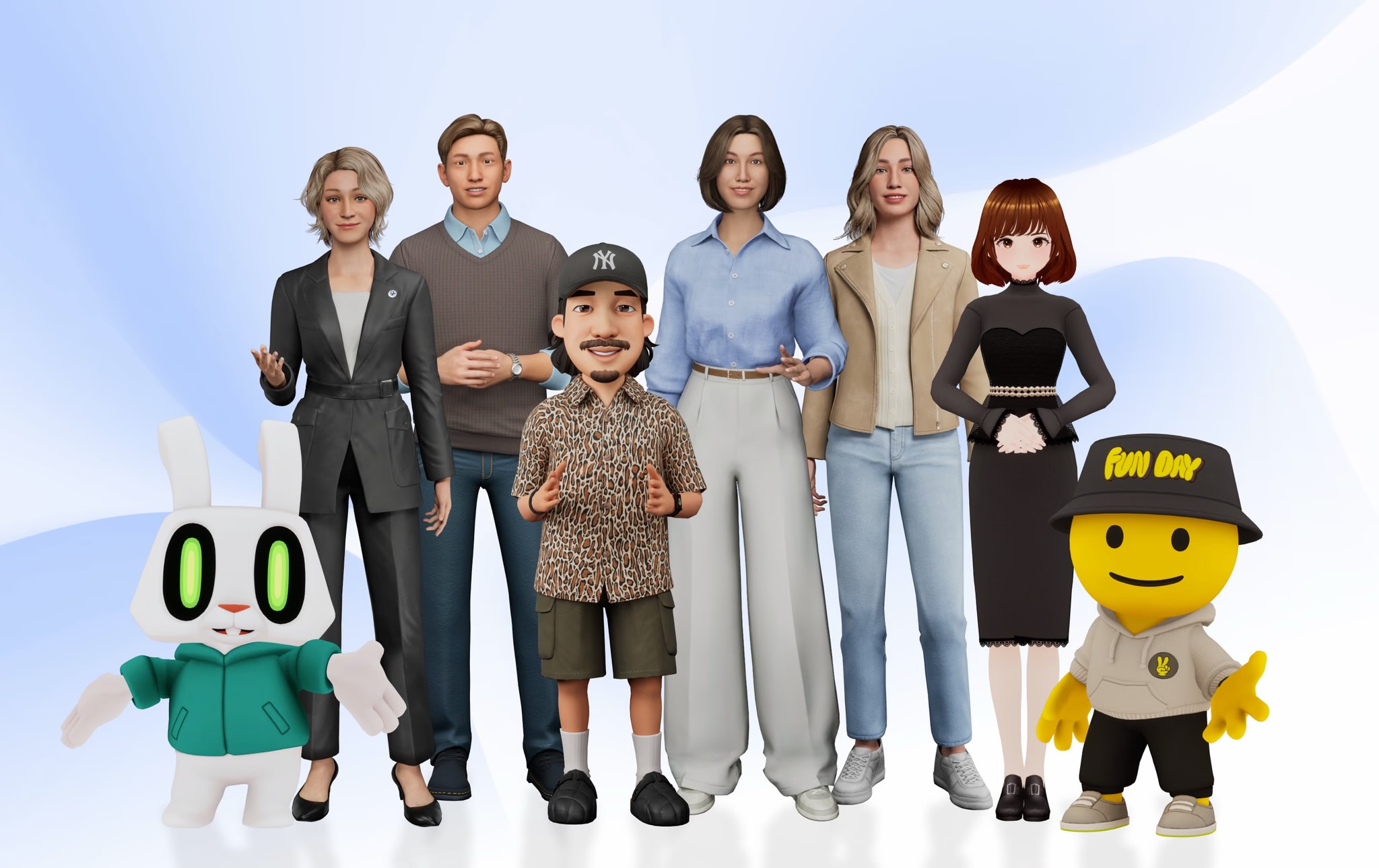
A visitor arriving at a hotel may prefer to ask a question rather than search through a website. Someone visiting an exhibition may want to speak to a product representative rather than read a list of specifications. A visitor entering a corporate facility may simply want to know where to go or who to see.
This is where the idea of an AI avatar becomes interesting. The technology can combine the intelligence of conversational AI with a more visible and approachable interface.
But Japan has shown us that the important question is not simply whether an AI avatar can talk.
The more useful question is: what should that interaction actually accomplish?
Japan already has a diverse AI avatar landscape
Japan is not a new market for digital customer interaction. A number of companies are already exploring different approaches to AI customer service and avatar-based experiences.
AI Sakura-san, for example, has been deployed in environments including stations and commercial facilities, combining an avatar interface with AI and customized customer-service scenarios. AVITA and its AVACOM platform take another approach, using avatars as an interface for remote customer service where human operators can remain involved. Selfbot has focused on making avatar creation more accessible, including the ability to generate avatars from photographs and combine them with AI-powered knowledge and FAQ functions. JetB's Uchi no AI has also expanded from text-based AI into voice-interactive avatars, including a 3D solution developed with Nikon.
We see these different approaches as useful examples of the questions the market is trying to answer. How much of the experience should be automated? When is a human operator still valuable? How important is the visual character? How easy should it be to create and customize an avatar? And, perhaps most importantly, when does an avatar create a better customer experience than a conventional chatbot?
These are not questions that only Japanese companies are asking. They are questions we are asking ourselves as we continue to develop Perxona.
Listening to what Japanese businesses are asking for
One of the most valuable parts of our conversations in Japan has been hearing the practical questions that come up repeatedly.
For many businesses, an AI avatar is only useful if it can work with their own information. A hotel needs to provide information about its facilities, restaurants, transportation, local attractions, and services. A manufacturer may need its avatar to understand product specifications and technical information. A company using an avatar for reception needs it to understand its facilities, departments, visitor procedures, and other internal information.
This has reinforced the importance of making knowledge management practical.
Perxona is designed so that organizations can connect their own content and knowledge to the AI experience, rather than building every possible conversation manually. This approach is particularly relevant for applications such as concierge services, reception, customer support, and product guidance, where customers may ask questions in many different ways.
Another recurring topic is language.
Japan's tourism and hospitality industries, in particular, have created strong demand for multilingual customer experiences. An AI avatar that can provide information in multiple languages could potentially help organizations support international visitors without requiring additional staff to be available for every interaction.
These conversations have helped reinforce our belief that multilingual interaction should be part of the product experience rather than something added later.
Learning by letting developers build
Our conversations with businesses tell us one part of the story. Working directly with developers has given us another perspective.
That is why we have been interested in creating opportunities for developers in Japan to experiment with Perxona rather than simply showing them finished demonstrations.
At our AI Avatar Hackathon in Tokyo, nine teams went from an empty repository to a working live demonstration in a single day. The projects were remarkably different, which was exactly what we hoped would happen.
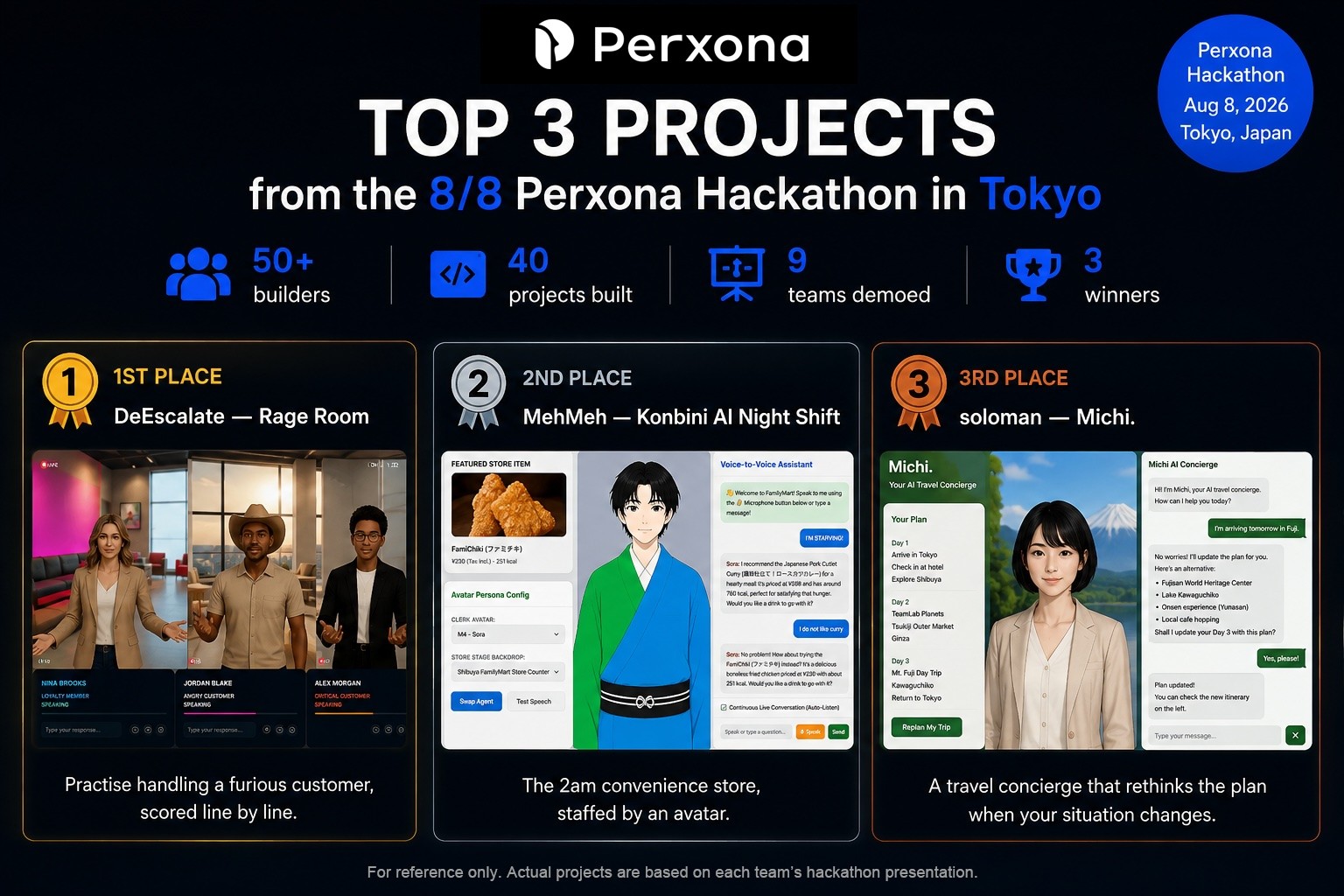
One team built a restaurant receptionist that watches the customer through a webcam and completes the booking through conversation, without using a conventional booking form. Another created a travel concierge in which an AI model could propose options while a separate deterministic system decided what was actually possible. Another team imagined a late-night convenience store staffed by three specialist AI clerks that customers could switch between with a gesture.
Other projects explored very different applications: a hotel concierge that could appear simultaneously on a guest's phone and a front-desk tablet, an AI mentor for professional certification exams, an ingredient-recognition experience that turned a photograph into an interactive character, and even a training simulation designed to help people practice de-escalating an angry customer.
What interested us most was not simply the variety of ideas. It was the way developers were thinking about the relationship between the AI's intelligence and the avatar's physical presence.
Several teams treated the avatar's body as a separate channel from its speech. They experimented with controlling gestures during a conversation and validating available motion commands so that the AI could not simply invent movements that did not exist.
That is an important insight for us.
We don't want Perxona to prescribe one way of using an AI avatar. We want to provide the building blocks that allow developers to discover applications that we may not have anticipated ourselves.
Our Connect Kit is part of that approach. It is designed to allow developers to connect their own AI models and applications to Perxona, rather than requiring the Perxona platform to be the source of every piece of intelligence.
In many ways, the hackathon gave us a practical test of that philosophy. The teams found ways to use the platform that we had not specifically planned for, and they did it remarkably quickly.
That is exactly the kind of learning we value.
From AI reception to AI concierge
Another lesson we have taken from the Japanese market is that businesses do not always describe the problem in the same way that technology companies describe the solution.
A company may tell us that it is looking for an AI reception system. But what it really wants may be a way to welcome visitors, provide directions, answer basic questions, and make information available outside normal reception hours.
A hotel may be interested in an AI concierge, but its actual need could be much more specific: helping guests find restaurants, understand transportation options, discover local attractions, or learn more about hotel facilities.
A company considering an unmanned reception system may not primarily be looking for automation. It may be looking for a better visitor experience while reducing the amount of time employees need to spend handling routine questions.
This distinction has been useful for us.
Rather than thinking of Perxona simply as an AI avatar product, we are increasingly thinking about the different customer journeys it can support. The avatar is the interface, but the real value comes from what happens through that interface.
Why we chose real-time 3D
There are many ways to create an AI character. A photograph can be animated, a 2D character can speak, a video can be generated, and a remote human operator can control an avatar.
All of these approaches have potential applications.
For Perxona, we have chosen to invest in real-time 3D because we believe it provides flexibility for the types of experiences we are trying to create. A 3D avatar is not simply a video that plays back. It can move, gesture, react, and express itself dynamically as the interaction develops.
This is also why we have been working on Behavior AI™, which connects the avatar's movements and expressions to the interaction rather than relying entirely on predetermined animations.
The goal is not to make an avatar that moves simply for the sake of looking impressive. We are interested in whether those movements can make the interaction feel more natural and engaging.
The developer experiments in Tokyo reinforced this idea for us. When developers began treating the avatar's body as something that could be designed and controlled independently from the AI's speech, we saw possibilities that go beyond simply putting a talking face on a chatbot.
That is an area we are continuing to develop, and our work with customers and developers is helping us understand where it matters most.
Learning from real-world applications
One of the most useful aspects of working in Japan has been the opportunity to move the conversation beyond demonstrations and into potential real-world applications.
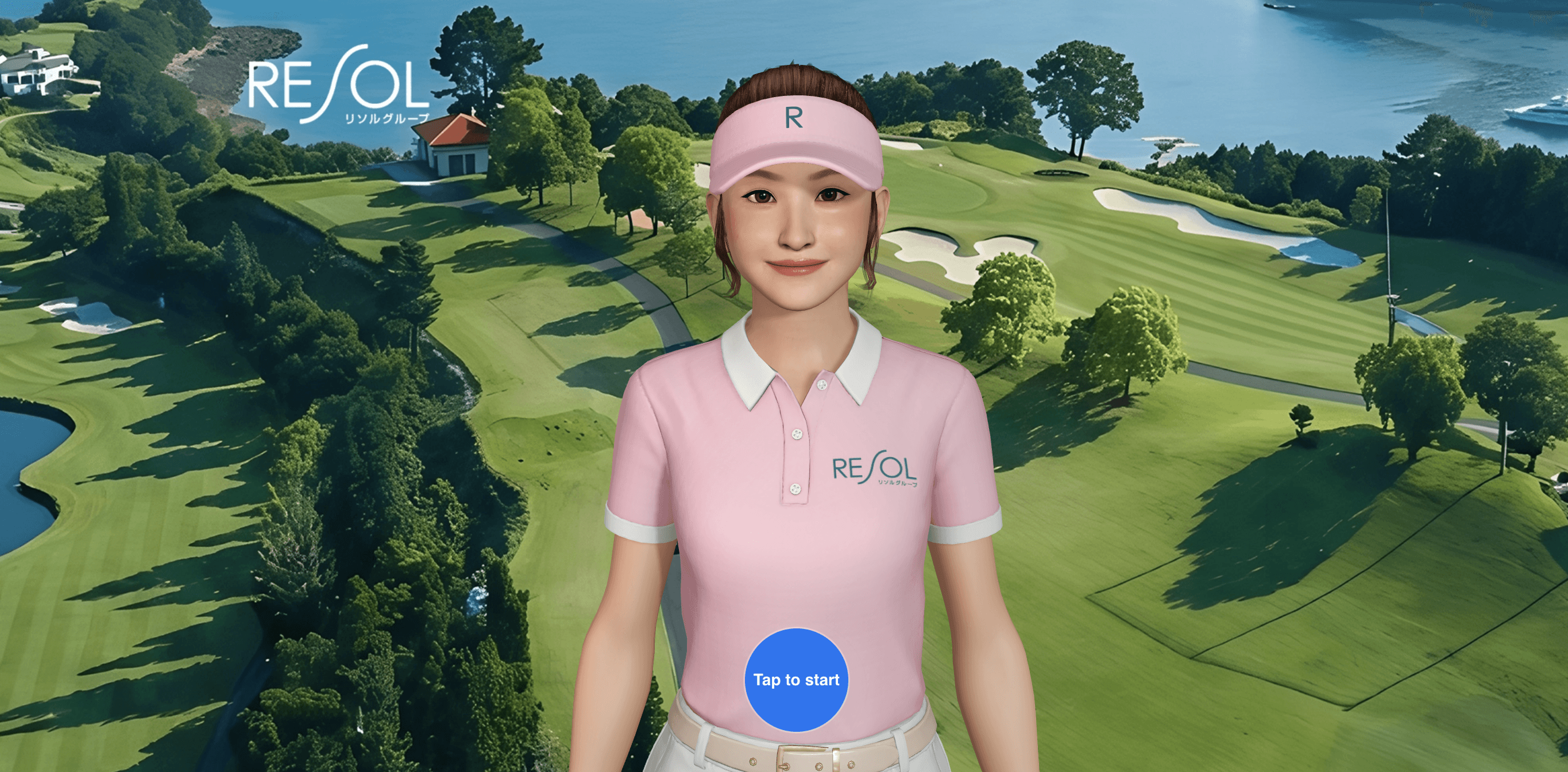
In the hospitality sector, for example, Perxona has been used in an environment where an AI avatar can provide guests with information about golf, dining, transportation, sightseeing, and other services.
For us, the interesting part is not simply that the avatar can answer these questions. It is what happens when the technology becomes part of an actual customer journey.
A guest may not know exactly what information they need. They may ask one question and then follow up with another. They may change the subject, ask in a different language, or want a recommendation rather than a factual answer.
That is very different from navigating a static FAQ.
Experiences like these help us think more carefully about what makes an AI avatar genuinely useful and where conversational interaction can add value.
The same principle applies to the developer projects we saw in Tokyo. The most interesting applications were not necessarily the ones with the most sophisticated technology. They were the ones where the presence of an avatar changed what the user could actually do.
That is an important distinction for us.
What we are still learning
If working with Japanese businesses and developers has taught us anything, it is that there is no single definition of an AI avatar market.
Different industries have different requirements. A hotel has different needs from a manufacturer. A public facility has different concerns from an e-commerce website. An exhibition booth has different requirements from a corporate reception area.
Companies also have different expectations around automation, branding, security, content management, languages, and customer experience.
For that reason, we do not see our job as simply taking an existing product and assuming that it will work everywhere.
Our job is to listen, test, learn, and continue adapting.
Our workshops and hackathons have become an important part of that process. They give us an opportunity to put Perxona in the hands of people who will challenge our assumptions, experiment with unexpected applications, and sometimes find uses for the platform that we had not considered.
That feedback is valuable precisely because it is not always predictable.
Where we are taking Perxona
The conversations we have had in Japan, together with what we have learned from developers building with Perxona, are influencing several areas of our ongoing product development.
We are continuing to make it easier for organizations to connect their own knowledge and content to an AI avatar, create different personalities and experiences, support multilingual interactions, and deploy avatars across different environments.
We are also continuing to work on making avatar behavior more natural, giving businesses and developers greater control over the way their avatars communicate, and reducing the technical expertise required to create and maintain an experience.
At the same time, we want to keep the platform open enough for developers to experiment.
We do not know exactly what the Japanese market will look like five years from now. We also do not think anyone can know that with certainty.
What we can do is continue listening to the companies, partners and developers who are exploring these technologies with us and use what we learn to make Perxona more useful.
Building the next generation of customer interaction together
Perhaps the biggest lesson we have taken from Japan so far is that the conversation should not begin with the question, "Do you want an AI avatar?"
It should begin with a different question:
Where could a better interaction help your customers?
For one organization, that might mean an AI concierge in a hotel. For another, it could be an AI reception system at a corporate facility, a virtual reception experience for visitors, or an interactive product specialist on an e-commerce website.
And there may be applications we have not thought of yet.
The developers at our Tokyo hackathon gave us a good reminder of that. In less than a day, they found ways to turn Perxona into a restaurant receptionist, travel concierge, convenience-store team, training coach, hotel concierge, and much more. Those weren't applications we had handed them as predefined templates. They were ideas they discovered by experimenting with the platform.
That is one of the reasons we value our conversations with Japanese partners and developers.
We are not entering the market believing that we already have all the answers.
We are coming to Japan to listen, learn, build, and discover what AI avatars can become together.
And those conversations—and the things people build with Perxona—are already shaping what we build next.
