Multilingual AI Avatars: How One Virtual Concierge Replaces a 5-Language Support Team
76% of consumers prefer buying in their native language. Most businesses still greet every visitor in English. Here is what that mismatch is costing you—and how interactive AI avatars close the gap in real time.
The Cost Problem Hiding in Plain Sight
Europe welcomed 793 million international tourists in 2025. The US processed 68 million. Global arrivals are projected to hit 1.58 billion in 2026. That is a staggering volume of people arriving at hotel lobbies, browsing ecommerce storefronts, and asking questions—often in a language your team cannot answer in.
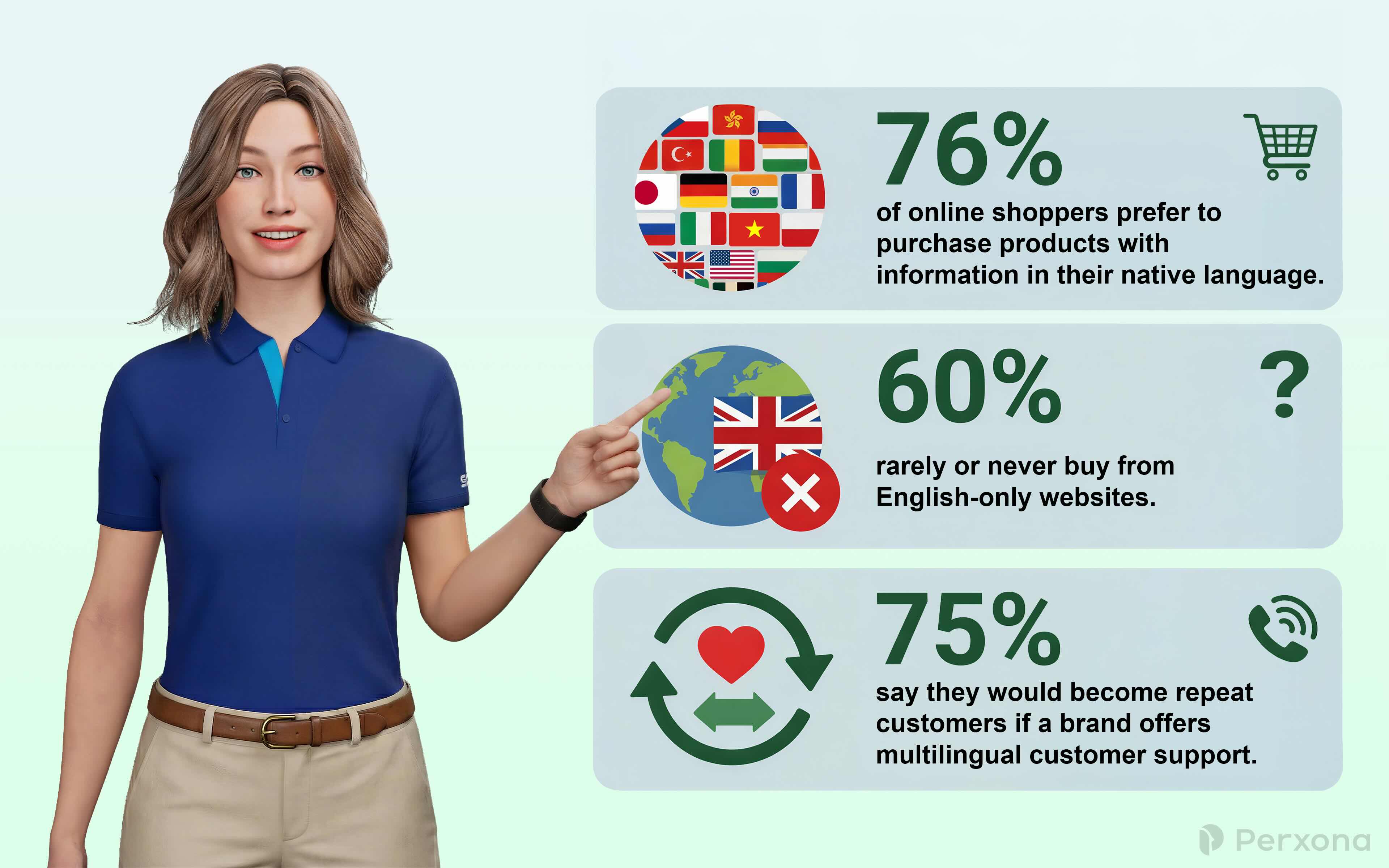
The numbers tell a clear story. According to CSA Research’s landmark survey of 8,709 consumers across 29 countries, 76% of online shoppers prefer to purchase products with information presented in their native language. Sixty percent rarely or never buy from English-only websites. And 75% say they would become repeat customers if a brand offered multilingual customer care.
Yet for most businesses—whether a boutique hotel on the Amalfi Coast or a DTC skincare brand shipping to twelve countries—providing that multilingual support means one thing: headcount. A single bilingual support agent in the US costs $45,000–$65,000 per year. Scale that across five languages, three shifts, and weekends, and you are looking at price tag you cannot justify.
Outsourced multilingual call centers bring the per-hour cost down to $7–$25 depending on region, but they introduce a different set of problems: brand inconsistency, limited product knowledge, and—critically for hospitality—zero warmth. A guest calling from their room about a late checkout does not want to feel like they have been routed to a call center in another time zone.
This is the gap that multilingual AI avatars were designed to close.
Why “Multilingual” Alone Is Not Enough—You Need Real-Time Interaction
The market is flooded with tools that claim multilingual capability. Translated chatbot scripts. Dubbed AI videos. Pre-recorded avatar clips localized into a dozen languages. These solutions check a box, but they fail to solve the actual problem: real-time, context-aware conversations with customers who have questions that are not in your FAQ.
Consider the difference. A pre-recorded multilingual video can explain your hotel’s spa amenities in Mandarin. That is useful. But when a guest asks whether the spa offers prenatal massage on a Tuesday afternoon in July, the video has nothing to say. A translated chatbot can attempt the question, but it strips away tone, facial expression, and the kind of body-language warmth that defines hospitality.
Interactive multilingual AI avatars operate in an entirely different category. They combine three capabilities that, until recently, existed in separate products:
Real-time natural language processing that understands context, intent, and follow-up questions across languages—not just keyword matching against a phrase book.
Emotionally expressive 3D rendering that mirrors the warmth of a human concierge. A smile when greeting, a thoughtful pause when considering a recommendation, appropriate eye contact throughout.
Dynamic knowledge integration that connects the avatar to your product catalog, room inventory, booking system, or CRM—so it answers with current, accurate information rather than scripted generalities.
The result is something that feels less like a tool and more like a team member—one that happens to speak every language your customers do, works every shift, and never needs onboarding when you update your menu or product line.
The Tourism Use Case: A Concierge That Speaks Every Guest’s Language
Sixty-five percent of global travel leaders identified chatbots, virtual assistants, and AI-powered customer service as the highest-impact application of generative AI in their industry. But there is a tension embedded in that statistic: guests do not actually want to talk to a chatbot.
A 2026 study from the University of South Florida found that while hotel staff are significantly more enthusiastic about AI adoption than guests, most guests still prefer face-to-face service—especially for requests with emotional nuance. The guest celebrating an anniversary wants a human touch. The guest asking what time the pool closes at 11 PM does not.
This distinction matters because it defines where multilingual AI avatars create the most value: handling the 80% of routine, language-dependent interactions so your staff can focus on the 20% that require genuine human empathy.
Picture a luxury resort on the Mediterranean. Fifty-five percent of guests arrive from outside the host country. The property currently employs front-desk staff who collectively cover English, French, and German. That leaves gaps for Spanish, Italian, Mandarin, Arabic, and Japanese-speaking guests—who, when they cannot communicate comfortably, default to shorter interactions, fewer add-on bookings, and lower satisfaction scores.
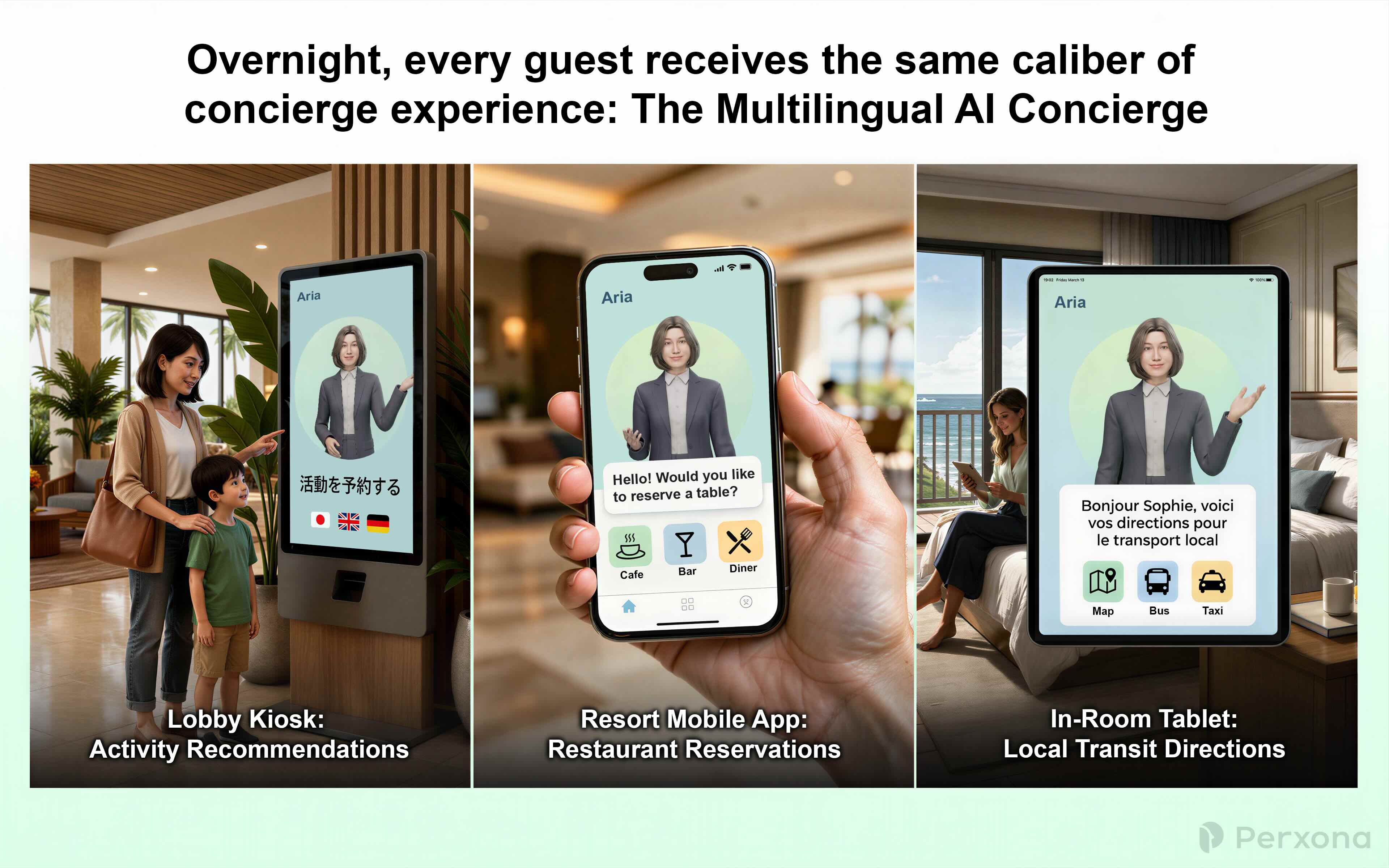
Now place a multilingual AI avatar on a lobby kiosk, the resort’s mobile app, and the in-room tablet. Overnight, every guest receives the same caliber of concierge experience: activity recommendations, restaurant reservations, spa bookings, local transit directions—all in their native language, all with the visual warmth of a character designed to reflect the property’s brand personality.
The data supports the impact. Hotels using AI-powered guest-facing assistants report guest satisfaction increases of up to 25% and front-desk inquiry volume reductions of nearly 40%. Scale that across a 300-room resort during peak season, and the operational relief is substantial.
The Ecommerce Use Case: A Global Storefront That Actually Feels Local
In ecommerce, the language problem manifests differently—but the cost is just as real. Cart abandonment on cross-border transactions runs significantly higher than domestic rates, and language friction is a primary driver. When a shopper in Seoul lands on your US-based product page, even a well-translated static page cannot answer the question forming in their mind: “Will this run large on my frame? What is the return policy for international orders?”
This is where interactive multilingual avatars diverge from the localization tools that ecommerce teams already use. Translation plugins handle static content. Multilingual chatbots handle scripted FAQs. But a 3D AI avatar integrated into your product page can do what a great retail associate does on the floor of a flagship store:
Greet the shopper in their detected language, establishing immediate comfort and signaling that this store was built for them.
Answer sizing, compatibility, and material questions in real time, drawing from your product database—not a static FAQ. A fashion shopper asking “Is this true to size for European measurements?” gets a specific, contextual answer.
Guide cross-sell and upsell recommendations conversationally, the way a skilled associate would: “Customers who purchased this jacket often pair it with this scarf—would you like to see it?”
Handle objection resolution at the moment of hesitation. When the exit-intent trigger fires, the avatar can surface shipping timelines, return guarantees, or a limited offer—in the shopper’s language, with the tone calibrated to reassure rather than pressure.
Early adopters of AI avatar-guided shopping are reporting conversion rates of 12% compared to 3% for standard email campaigns, and customer satisfaction improvements of 42% in categories where the avatar assists with product selection. The multilingual layer amplifies those results because it expands the addressable audience to every visitor, not just the ones who happen to read English.
What to Look for in a Multilingual AI Avatar Platform
Not all multilingual AI avatar solutions are built equally. If you are evaluating platforms, here are the capabilities that separate real-time interactive avatars from repackaged video translation tools:
Real-time language detection and switching. The avatar should detect the visitor’s language automatically—and switch mid-conversation if the visitor code-switches (common among bilingual speakers).
Emotional and tonal calibration per language. Directness that works in German customer service can feel abrupt in Japanese. The avatar’s tone, pacing, and expression should adapt to cultural communication norms, not just vocabulary.
Live knowledge base integration. The avatar must connect to your actual inventory, booking system, or product catalog—not a static knowledge base that goes stale the moment you update a price or policy.
No-code persona management. Your marketing or operations team should be able to update the avatar’s personality, tone, and scripted greetings without filing a ticket with IT or waiting on a vendor’s professional services team.
The Bottom Line
1.58 billion international travelers will cross a border in 2026. Hundreds of millions of cross-border ecommerce transactions will happen this quarter alone. Every one of those interactions is a moment where language either builds trust or creates friction.
The businesses that win will not be the ones with the biggest multilingual staff budgets. They will be the ones that deploy technology capable of real-time, emotionally intelligent, context-aware multilingual interaction—at scale, 24 hours a day, across every digital touchpoint.
That is not a chatbot. That is not a dubbed video. That is an interactive AI avatar—and it is the single highest-leverage investment a tourism or ecommerce brand can make in multilingual customer experience right now.
Ready to see it in action?
Explore Perxona.ai’s interactive avatar plans in our 2026 Pricing Guide, or see a multilingual avatar handle a real conversation for many of our partners.
